Expert Insights: Choosing the Best Solar System Setup for Your Park

By Amin Bazyan, Design Engineer at Detra Solar.
Introduction
Choosing the right solar system setup for a utility-scale solar park requires more than comparing equipment specifications or minimising upfront costs. Design decisions made early in the project directly affect energy yield, operational reliability, and the Levelized Cost of Energy (LCOE) over the plant’s 25–30 year lifetime.
A structured techno-economic feasibility analysis allows developers and designers to evaluate multiple system configurations in the context of site conditions, grid requirements, and long-term financial objectives. While lower CAPEX may appear attractive, it can lead to higher OPEX or reduced energy production over time.
This article presents a side-by-side comparison of key solar park design options, focusing on the technical and economic trade-offs that influence long-term performance and value.
Key System Elements Being Compared
There are many items that affect the LCOE in a solar system. In this article, we will tackle 3 main components that dictate the success of your solar park. Understanding the differences may help you choose the best solution for your project.
These 3 components are the Photovoltaic (PV) modules (how solar energy is captured), the mounting structure (how PV modules are supported), and inverter architecture (how power is converted).
Side-by-Side Comparisons
Monofacial vs. Bifacial Modules
Monofacial modules, as the name suggests, function by collecting sunlight from one side only, the front side. On the other hand, bifacial modules are able to collect sunlight from both sides. Monofacial modules preceded the bifacial modules. While you would assume market maturity favors the earliest technology, the bifacial modules outperformed its ancestor module. The following table highlights the key differences between both types.
Table 1: Monofacial and bifacial modules comparison
Type | Monofacial Modules | Bifacial Modules |
Functionality | Collects sunlight from the front side | Collects sunlight from both sides |
Efficiency | Varies between cell technology and manufacturer, but commercially available modules may reach 25% | Varies between cell technology, purity and manufacturer, but commercially available modules are around 16% – 20% |
CAPEX | Lower | Higher |
Energy Generation | Standard | Higher |
Performance With Shadow/Snow | Worse | Better due to reflection on the backside |
Lifespan | Mostly 25 years | Up to 30 years |
Weight | Lower. Easier to mount | Higher. Requires more handling |
Energy Yield Predictability | Straightforward | More sophisticated |
One interesting study was issued by Vilnius Tech under the title “Techno-Economic Comparison of Bifacial vs Monofacial solar panels”. The study compares the modules mentioned in this article for a 35 MWp plant through analyzing the current market tariffs and conducting a Monte Carlo analysis to estimate the tariff on the long run. The study concluded that, despite Bifacial modules being more expensive, they led to an increase of the Net Present Value (NPV) by 12.2% in comparison to the monofacial modules.
Fixed Tilt vs. Single-Axis Tracker Systems
The mounting structure plays a significant role in determining the plant’s efficiency and effectiveness, CAPEX, and OPEX. Out of all possible mounting structure configurations, fixed-tilt structures, with their simplicity and cost effectiveness, and single-axis tracker with their higher-investment costs and more efficient performance are the dominant players in this field.
Fixed structures are simple to erect and are a more reliable option given that there are no mechanical moving parts, meaning they will require less maintenance. This is a trade-off with lower efficiency as PV modules won’t be able to track the sun’s movement causing them to not perform optimally.
Single-axis trackers provide a more-efficient approach to capture solar energy. These systems follow the sun’s path by rotating over a single axis, which allows for higher energy output in comparison to the fixed tilt structures. Nevertheless, such configuration can be automated with advanced algorithms, such as backtracking, to allow for even better performance and reduction in row-to-row shading. The disadvantage of such systems is that they require higher CAPEX and OPEX due to their sophistication and moving mechanical parts, in addition to their sensitivity to environmental factors.
One of the major complexities in Single-axis tracker is determining the load path. A load path is the route force takes through a structure until it dissipates into the ground. Knowing this allows the structural designer to properly design a safe and rigid structure. In a fixed-tilt structure, given that the structure is static at all times, the forces, either wind or snow, are transferred from modules to the mounting rails. From there, these loads move through the support posts into the foundation. It is a predictable solution with no dynamic variable as can be seen in the figure below.
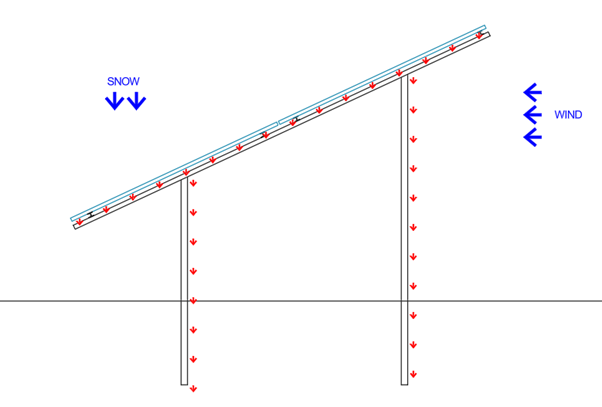
Figure 1: Simplified load path in fixed-tilt structure
On the other hand, single-axis trackers rotate the panels around the torque tube. Every specific angle within the rotational angle has different dynamic behavior due to the changes in wind and snow forces that the structural designer must take into consideration. The figure below, shows different load paths (each arrow with a different color). These complex forces do not exist in a fixed-tilt structure.
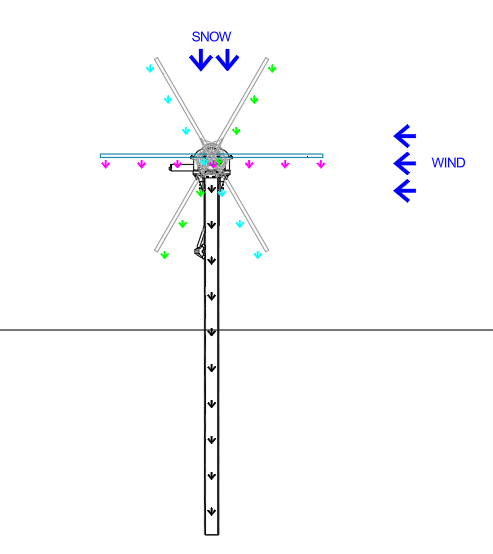
Figure 2: Simplified load path in single-axis tracker structure
To understand the energy gains from a single-axis trackers, a paper published by the University of Patras in the 29th European Photovoltaic solar Energy Conference and Exhibition under the title “Single Axis Tracker Versus Fixed Tilt PV: Experimental and Simulated Results” conducted analysis in Greece for a small scale system. The results showed experimental higher energy generation of 23% for the single-axis tracker when compared to the fixed-tilt structure.
String vs. Central Inverters
Inverters are used in solar parks to convert the direct current (DC) electricity generated by the PV modules into a grid-compatible alternating current (AC) power. There are 2 main inverter architectures that are utilized commercially, string and central inverters.
The core difference between string and central inverters is that string inverters, which are smaller in size, are located at the end of the string or midpoint of the number of strings that are connected to it. On the other hand, central inverters, which have a larger footprint and are enclosed in a containerized solution, have a larger number of strings connected to it and must be placed efficiently.
The following table compares, in more depth, string and central inverters.
Table 2: String vs central inverters comparison
Type | String Inverters | Central Inverters |
Power Rating | Up to 350 kVA per unit | 1 – 5 MVA per unit |
CAPEX | Higher per watt | Lower per watt |
Efficiency | Higher because they have higher number of maximum power point trackers (MPPTs) | Lower as they have 1 – 2 MPPTs |
Balance of System (BOS) | On the DC side, no combiner boxes are required. However, on the AC side, extensive connections. | Requires DC combiner boxes, but reduced cables on the AC side. |
Ease of Installation | Labor intensive as due to the installation of a large number of inverters. Terrain status does not affect it directly as they can be installed on the back of the structure | Straightforward. Skid installed via a crane in a flat site. More complex when sites are steep |
Reliability | Higher. Failure of one unit would lead to the loss of power from the panels connected to it (e.g., 1% of the plant) | Lower. Single point of failure. It can lead to the loss of power generation for significant part of the plant |
Operations and Maintenance (O&M) | Easy and straightforward | May require certified personnel |
Grid Support | Complex due to the need to sync a large number of units. Harmonics may be difficult to suppress. Common mode voltage, reactive power regulation, active power regulation and other functions may be harder to obtain | Easier to coordinate reactive power, active power and other functionalities |
A master’s thesis published by LUT University under the title “A Comparative Analysis of Central and String Inverters for Utility Scale Photovoltaic Plants: Cost, Efficiency and Performance” showed that string inverters resulted in ~1% higher energy output. This is in line with an article posted under the title “Technical and Economic Optimal Solutions for Utility-Scale Solar Photovoltaics Parks” where it focused on showing the LCOE for each inverter configuration, and the string inverter resulted in a better value. Another interesting read is the “Identifying Critical Failures in PV Systems Based on PV Inverters’ Monitoring Unit: A Techno-Economic Analysis” which showed that central inverters triggered more alarms than string inverters, which concludes that central inverters require intensive performance performance tracking.
Site & Environmental Factors
While you may favor specific configurations over the other from what you have already read, the final design of the solar park is not straightforward. The location of the solar park plays a crucial part in selecting the optimal and cost effective solution.
When it comes to the type of modules to install, bifacial seems to be a no brainer. When the site’s ground consists of white gravel, dry sand, snow or any light color reflective soil, this is the case. However, when you have a dark topsoil or heavy vegetation, the added benefits from bifacial modules are diminished.
Selection of the type of structure goes through multiple stages in assessing the location. Initially, the location in reference to the equator. On the equator, the sun travels almost directly overhead year-round, meaning the added benefits of a tracker system is negligible and a fixed structure suffices.
Next, the slope of the site. Flat terrains are not always available, and levelling sloped lands are either expensive or not allowed by regulators. Therefore, you will need to choose the technology that suits the existing situation of the terrain. When it comes to fixed-tilt structures, they are suitable for almost all terrain types given that you are able to increase/reduce the table size to make it follow the terrain. Manufacturers recommend having a maximum North-to-South (NS) slope of 25% and 15% – 25% East-to-West (EW) slope. These values may vary depending on the material of the structure and the geotechnical analysis. On the other hand, modern single-axis trackers are terrain-following trackers which allows them to fit a NS slope of 15% and EW slope of 15% – 20%.
Additionally, given the structural complexity of a single-axis tracker, areas with high wind speed are not suitable for such installations as they would require expensive modifications to the design which may affect the feasibility of the project.
Lastly, since fixed systems require menial maintenance, for remote applications, fixed-tile structures are more recommended.
As for the inverters’ architecture, it comes down to the grid operator’s requirements, available land area and budget. Grid operators may require more dynamic control and monitoring on the behavior of the inverters, which gives edge to central inverters, especially in cases where a high number of string inverters would be installed.
Conclusion
In many utility-scale projects, combinations such as bifacial modules, single-axis trackers, and string inverters often emerge as strong performers from a techno-economic perspective. However, site-specific constraints and project objectives ultimately determine the optimal configuration.
A comprehensive feasibility analysis and well-structured design process are essential to maximising energy yield, controlling lifecycle costs, and achieving long-term investment performance.
A Structured Approach to Utility-Scale Solar Design
Planning a utility-scale solar park involves balancing technical performance, financial viability, and site-specific constraints – all within an evolving regulatory and grid environment. A structured optioneering and design approach is critical to making informed decisions early and avoiding costly compromises later in the project lifecycle.
At Detra Solar, we support developers, EPCs, and investors with independent solar and storage design and consultancy services, covering everything from early-stage feasibility and concept design to detailed engineering and Owner’s Engineering support. Our focus is on evaluating multiple system configurations, quantifying their technical and financial impacts, and identifying solutions that deliver robust, long-term performance.
If you are planning a new utility-scale solar park or reviewing design options for an existing project, get in touch to discuss how a tailored, data-driven design approach can strengthen your project’s technical and financial outcomes.
Register for an online consultation
If you’d like to discuss your upcoming projects or learn more about our services, please reach out to us. Our team of experts is ready to provide tailored solutions and support to ensure the success of your solar and energy storage projects.
References:
- Kumbaroğlu, G. S., Çamlibel, M. E., & Avcı, C. (2021). Techno-economic comparison of bifacial vs monofacial solar panels. Engineering Structures and Technologies, 13(1), 7–18. https://doi.org/10.3846/est.2021.17181
- Perraki, V., & Megas, L. (2014). Single-axis tracker versus fixed-tilt PV: Experimental and simulated results. In Proceedings of the 29th European Photovoltaic Solar Energy Conference and Exhibition, Amsterdam, Netherlands.
- Ngwenyi, E. A. (2025). A comparative analysis of central and string inverters for utility-scale photovoltaic plants: Cost, efficiency and performance (Master’s thesis). Lappeenranta–Lahti University of Technology (LUT). https://lutpub.lut.fi/handle/10024/170629
- Monteiro, F., Sarquis, E., & Costa Branco, P. J. (2024). Identifying critical failures in PV systems based on PV inverters’ monitoring unit: A techno-economic analysis. Energies, 17(18):4738. https://doi.org/10.3390/en17184738